2026.09.03
Sagging Cheeks in Your 40s — How to Restore Your Jawline Without Surgery
Five scientific causes of sagging cheeks in your 40s and a side-by-side comparison of Ulthera, thread lift, and manual contour care. A data-driven guide to restoring your jawline without surgery.
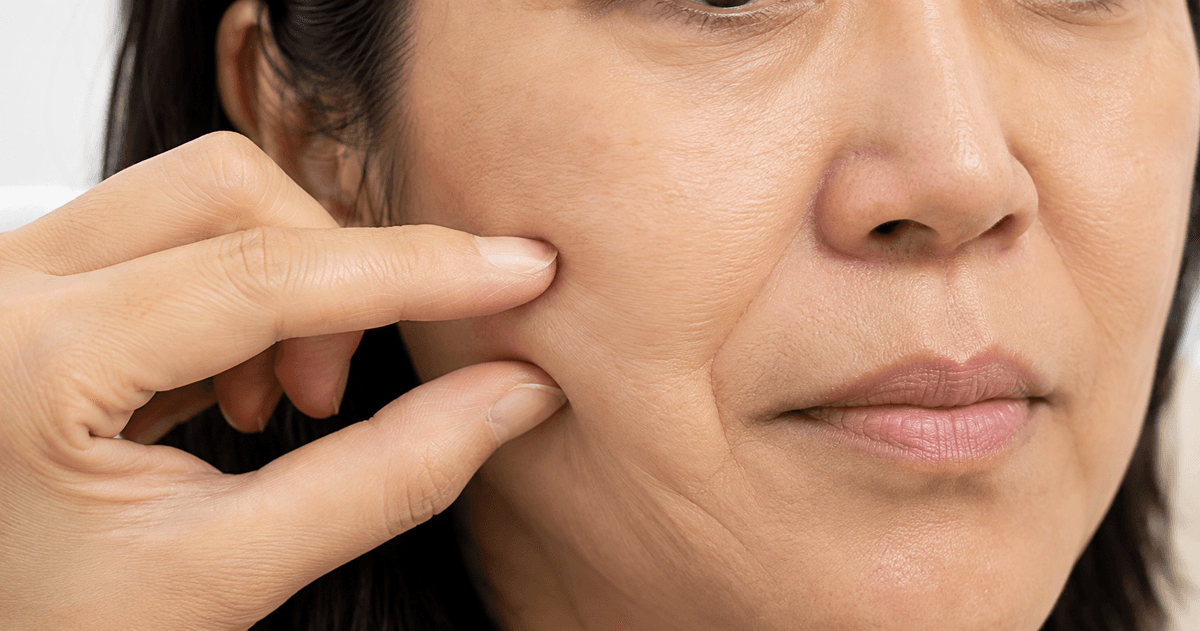
When Did My Side Profile Start Looking Like This?
One day you are scrolling through family photos and you pause. Your face from three years ago looks noticeably different from today. Your cheeks have dropped, your jawline has blurred, and the nasolabial folds around your mouth have deepened. A slight tilt of the chin reveals a double chin you do not remember having.
This is not simply weight gain. Sagging cheeks in your 40s result from complex changes across skin, fascia, fat pads, muscles, and the lymphatic system. Understanding the causes is the first step toward finding an effective solution.
Five Scientific Causes of Sagging Cheeks in Your 40s
1. Collagen and Elastin Decline
Collagen decreases by roughly 1% per year after age 25. By your 40s, total collagen volume is 20-25% lower than in your 20s, weakening the skin's ability to support heavy cheek tissue against gravity.
2. SMAS Layer Laxity
The Superficial Musculo-Aponeurotic System is the connective-tissue framework that holds facial contours in place. As it loosens with age, cheek tissue migrates downward — the same structural layer targeted in surgical facelifts.
3. Malar Fat Pad Descent
The malar fat pad, positioned high on the cheekbone in youth, slides downward over time. This creates hollowing below the cheekbone and deepens nasolabial folds as displaced volume accumulates around the mouth.
4. Masseter and Jaw Muscle Imbalance
One-sided chewing, clenching, and teeth grinding create asymmetric masseter development. The overdeveloped side appears angular while the weaker side sags more, contributing to an uneven jawline and double chin.
5. Sluggish Lymphatic Circulation
Reduced lymphatic drainage leads to chronic facial puffiness that amplifies the appearance of sagging and blurs the jawline further.
Comparing Lifting Options: Medical Procedures vs. Manual Contour Care
| Factor | Ulthera (HIFU) | Thread Lift | Manual Contour Care |
|---|---|---|---|
| Mechanism | Ultrasound heat energy | Dissolvable thread insertion | Fascia release + lymph + muscle realignment |
| Onset of results | 2-3 months | Immediate | Noticeable after first session |
| Duration | 6-12 months | 1-2 years | Long-term with habit correction |
| Pain level | High | Moderate (with anesthesia) | Mild |
| Downtime | Swelling 1-2 weeks | Bruising and swelling 2 weeks | None |
| Cost | KRW 500K-1M | KRW 800K-2M | KRW 130-150K per session |
| Asymmetry correction | Limited | Limited | Customized left-right balancing |
Ulthera and thread lifts offer measurable results but come with higher costs, downtime, and limited ability to address facial asymmetry. Manual contour care provides an accessible, no-downtime alternative that can be repeated regularly and tailored to each side of the face independently.
Why Manual Contour Care Works for Sagging Cheeks
Direct Fascia Release — Hands-on techniques release tension and adhesions in the fascial layer above the SMAS, creating space for displaced cheek tissue to return toward its original position. The practitioner detects subtle tension differences in real time and adjusts pressure accordingly.
Lymphatic Drainage — Stimulating lymph flow removes retained fluid and waste, sharpening the jawline and reducing puffiness that makes sagging look worse.
Masseter Relaxation — Releasing overtight masseter muscles softens the jaw angle and restores balance to the lower face, reducing double chin appearance.
Asymmetry-Specific Treatment — Each side is analyzed and treated differently: more intensive lifting on the sagging side, more relaxation on the overdeveloped side. This level of customization is difficult to achieve with device-based treatments.
OM Aesthetic's Plaster-Cast Measurement System
OM Aesthetic uses a plaster-cast 3D recording system to measure facial contour changes down to the millimeter. Before-and-after casts provide objective, numerical proof of improvement rather than relying on subjective impressions.
The process includes precision analysis of asymmetry and sagging, customized treatment by Director Ming (13 years of experience), millimeter-level change documentation, and home-care guidance for habit correction.
Book Your First Consultation
- Location: 4-minute walk from Misa Station Exit 3
- Parking: 2.5 hours free in the underground garage
- Pricing: Asymmetry contour care KRW 130,000 / Precision asymmetry care KRW 150,000
- Booking: Naver Reservation or KakaoTalk
- Closed: Mondays
AUTHOR
Minji Oh (Director)
Founder, OM Aesthetic · 13 years luxury spa experience
Have questions? Book a free consultation.
Free Consultation