2026.09.03
Deepening Nasolabial Folds Are a Structural Problem, Not a Skin Problem
The real cause of nasolabial folds lies in facial structure that creams and fillers cannot fix. Learn how malar fat pad descent, fascial laxity, and masseter asymmetry create deep smile lines — and how manual contour care addresses the root cause.
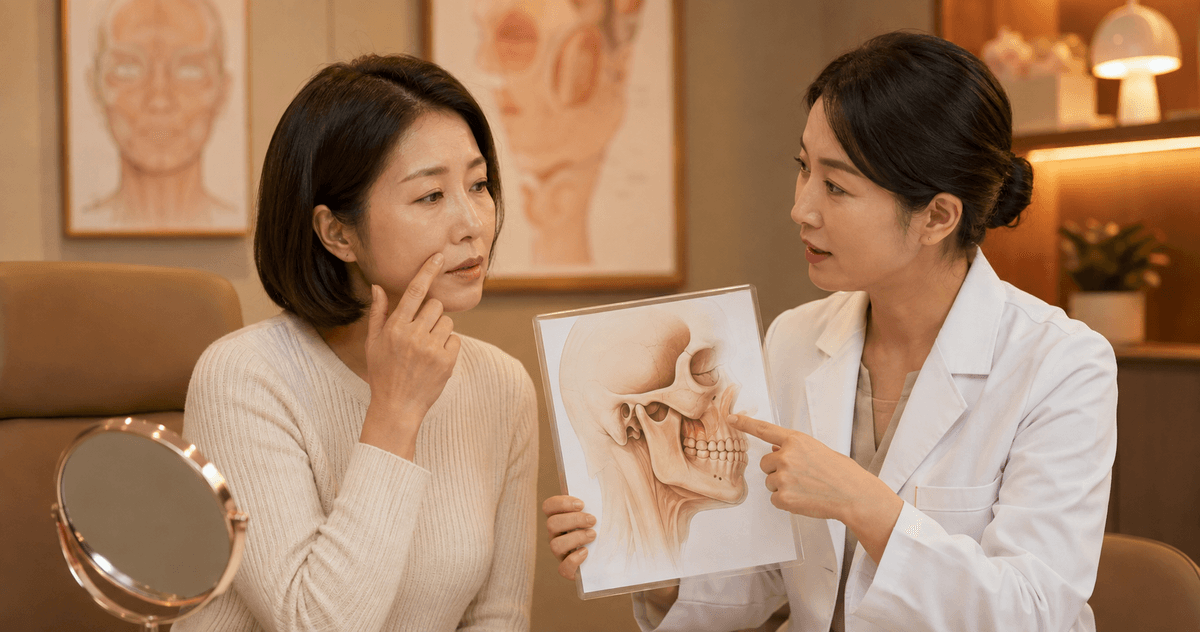
Nasolabial Folds Make You Look 10 Years Older
Every time you look in the mirror, those two deep lines running from your nose to the corners of your mouth catch your eye. You've tried expensive creams, facial massages, and even fillers — but the lines always come back.
If this sounds familiar, the reason is simple: nasolabial folds are not a skin problem. They are a structural problem.
The Real Causes of Deepening Nasolabial Folds
Most people assume nasolabial folds are caused by loss of skin elasticity. But the changes responsible for deep smile lines occur far beneath the skin surface.
Malar Fat Pad Descent
The malar fat pad sits over the cheekbone, giving the mid-face its youthful volume. With age, the retaining ligaments that hold this fat pad weaken, and gravity pulls the tissue downward. The descended fat pad accumulates beside the nose, creating the nasolabial fold.
Fascial (SMAS) Laxity
The SMAS layer acts as a supportive mesh connecting muscles to skin. When this fascia loses elasticity, it can no longer hold cheek tissues upward, causing the entire mid-face to sag and deepening the nasolabial line.
Masseter Asymmetry
Habitual one-sided chewing or teeth grinding causes uneven masseter development. The overdeveloped side pushes the cheek fat pad downward faster, resulting in one nasolabial fold being noticeably deeper than the other.
Orbicularis Oris Tension
Chronic tension in the muscle encircling the mouth locks the nasolabial line in its folded position, preventing the crease from relaxing even at rest.
Lymphatic Stagnation
Poor lymphatic drainage leads to fluid retention in the cheeks, adding weight that accentuates the nasolabial fold — which is why the lines often look worse in the morning.
Why Fillers Don't Provide a Lasting Solution
| Method | Target Layer | Effect on Folds | Duration | Root Cause Fix |
|---|---|---|---|---|
| Creams/Serums | Epidermis | Minimal | - | ✗ |
| Fillers | Dermis–Subcutaneous | Immediate | 6-12 months | ✗ |
| Thread Lift | SMAS–Subcutaneous | Good | 1-2 years | △ |
| Manual Contour Care | Fascia–Muscle–Lymph | Gradual | Long-term | ○ |
Fillers fill the groove but do nothing about the descending fat pad above it. Once the filler dissolves, the structural cause remains and the fold returns. Addressing the fascia, muscles, and lymphatic system directly is what produces lasting improvement.
How Manual Contour Care Improves Nasolabial Folds
Manual contour care uses precise hand pressure to target the structural layers responsible for nasolabial folds.
Fascial Release and Realignment — Releasing adhesions in the SMAS restores its ability to support the malar fat pad. As the cheek lifts, tissue no longer bunches beside the nose, and the fold softens.
Masseter Relaxation — Reducing masseter hypertension decreases downward pressure on the cheek, allowing the fat pad to remain in a higher position.
Orbicularis and Buccinator Balancing — Restoring natural tension balance around the mouth releases the "locked-in" crease of the nasolabial line.
Lymphatic Drainage — Clearing fluid retention reduces cheek puffiness and the shadow that accentuates the fold.
Side-Specific Customization — Each side is assessed and treated independently to correct asymmetric nasolabial folds.
OM Aesthetic's 5-Layer Analysis
At OM Aesthetic, Director Ming (13 years of experience) performs a 5-layer structural analysis before any treatment begins. A plaster cast captures millimeter-level differences in cheek height, fold depth, and skeletal asymmetry. Each layer — bone structure, fascia, muscle, fat, and lymph — is evaluated to identify the specific cause of your nasolabial folds.
| Layer | Assessment |
|---|---|
| 1 — Skeletal | Cheekbone position, maxillary projection, bilateral differences |
| 2 — Fascia | SMAS elasticity, adhesion points |
| 3 — Muscle | Masseter, orbicularis, buccinator tension and balance |
| 4 — Fat | Malar fat pad position and degree of descent |
| 5 — Lymph/Skin | Edema level, lymphatic stagnation zones |
Treatment Information
| Detail | Info |
|---|---|
| Asymmetry Contour Care | 130,000 KRW |
| Precision Facial Asymmetry Care | 150,000 KRW |
| Location | 4-min walk from Misa Station Exit 3 |
| Parking | Underground parking, 2.5 hours free |
| Booking | Naver Booking or KakaoTalk |
| Closed | Mondays |
If you've realized that the cause of your nasolabial folds is structural rather than superficial, it's time to change your approach. Before switching creams or repeating fillers, identify the root cause first. Director Ming's 13 years of expertise and 5-layer analysis will pinpoint exactly what's driving your nasolabial folds.
AUTHOR
Minji Oh (Director)
Founder, OM Aesthetic · 13 years luxury spa experience
Have questions? Book a free consultation.
Free Consultation